
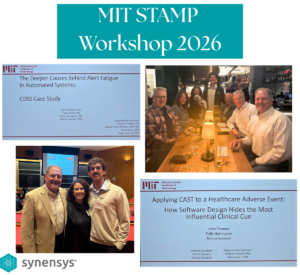
Each year, the STAMP workshop brings together a focused community of safety professionals, researchers, and practitioners working through the realities of complex systems.
In March, three members of our team, Abigail Harte‑Williams, Mark Smithwick, and Braden Burnett, attended the 2026 STAMP workshop, held March 23–26, to participate in those discussions and learn from others applying systems‑theoretic approaches across a range of industries.
The workshop centers on the Systems‑Theoretic Accident Model and Processes (STAMP) and related methods such as STPA and CAST. While grounded in theory, the event consistently emphasizes practical application. Many attendees return year after year to share what has worked in practice, areas for improvement, and what they continue to refine as systems and operating environments evolve.
What the Conference Focused On
This year’s sessions reflected a growing emphasis on how STAMP‑based approaches are being used in day‑to‑day work. Offerings ranged from introductory STPA and CAST training to more advanced discussions on scenario development and Safety Management Systems informed by systems thinking.
Several sessions explored applications of STPA beyond traditional accident analysis, including:
- Integrating human factors more explicitly into safety analysis
- Addressing operational and organizational contributors to risk in addition to technical failures
- Applying systems thinking in domains such as healthcare, aviation, defense, nuclear power, and AI‑enabled systems
Alongside the technical content, there was consistent discussion around challenges related to adoption. Across formal sessions and Birds‑of‑a‑Feather discussions, a common theme emerged. While interest in STAMP continues to grow, long‑term effectiveness depends heavily on leadership understanding, organizational readiness, and the ability to communicate these concepts beyond safety‑focused roles.
What Our Team Took Away
Throughout the week, Abigail, Mark, and Braden participated in both structured sessions and informal conversations with practitioners from a variety of disciplines. Several themes surfaced repeatedly.
One was the increasing attention given to human factors and unsafe control actions when applying STPA. Case studies from multiple industries demonstrated how these methods can help identify systemic contributors to human error, rather than treating errors as isolated individual mistakes. That perspective resonated broadly and highlighted how transferable systems‑theoretic approaches can be across domains.
Another recurring topic was the role of artificial intelligence in STPA. While there is growing interest in using AI to support early stages of analysis, many participants emphasized that these tools are most effective when used as a starting point. For safety‑critical systems, professional judgment, experience, and contextual understanding remain essential.
It was also noticeable that most organizations represented at the conference are applying STPA internally rather than offering it as a standalone service. Many conversations reflected the reality that STAMP‑based methods tend to be most effective when integrated into existing processes and adapted to specific organizational contexts.
Why This Matters
The systems people depend on today are increasingly interconnected and dynamic. As complexity grows, so does the importance of approaches that look beyond isolated failures to understand how safety is shaped by interactions across people, technology, and organizations.
Events like STAMP provide an opportunity to step back, compare approaches, and examine how safety is being addressed in practice. The insights gained through these conversations help inform how systems thinking continues to evolve and how organizations can apply it thoughtfully within their own environments.
Looking Ahead
Attending the STAMP workshop is less about returning with prescriptive solutions and more about staying engaged in an ongoing conversation. For our team, the week reinforced the value of practical application, open discussion about limitations, and continued learning alongside others navigating complexity in their respective fields.
We appreciate the opportunity to engage with this community and to bring those perspectives back into our ongoing work. For more information on our System Safety work click here.